Musical Terms
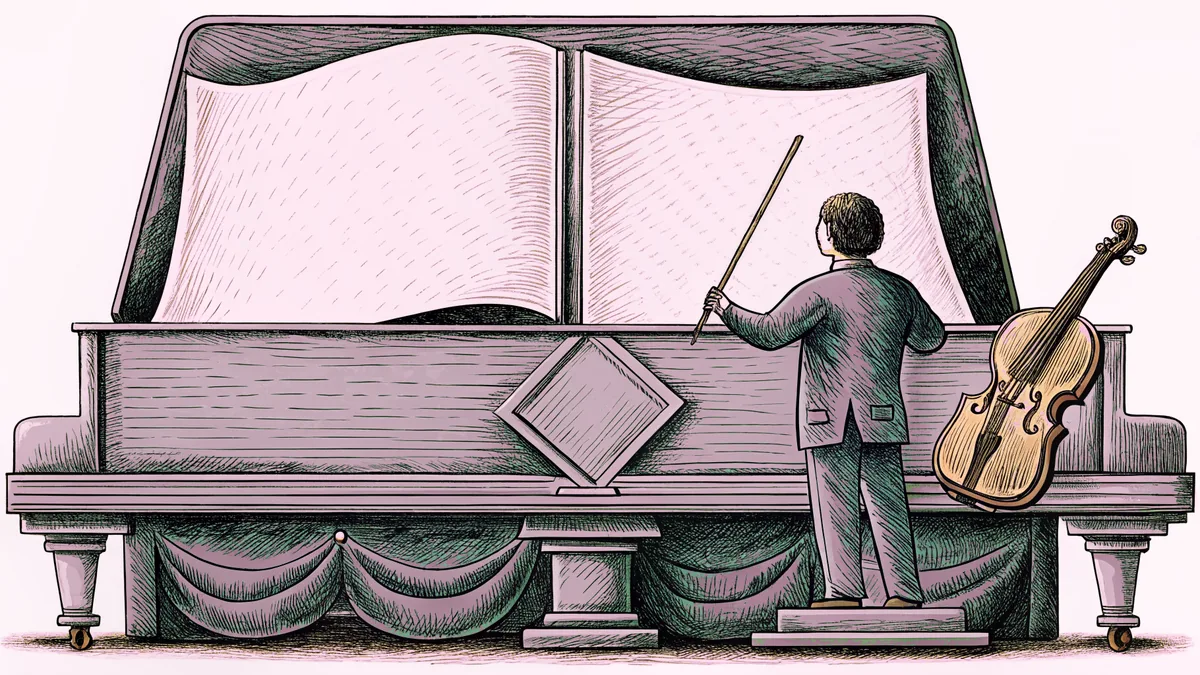
| A | T | A | E | B | S | N | O | Y | I | L | E | G | A | T | O | A |
| D | Q | T | H | H | J | T | O | N | A | R | P | O | S | S | V | I |
| A | I | U | A | C | T | Q | S | S | I | E | S | T | E | M | P | O |
| G | P | R | A | E | K | O | T | Z | I | H | R | T | L | E | W | I |
| I | P | I | S | R | L | D | U | E | C | N | E | U | V | T | X | O |
| O | I | L | A | D | T | N | V | O | O | N | U | A | S | U | Y | O |
| E | A | A | N | N | M | E | N | E | O | S | T | I | N | A | T | O |
| F | O | T | T | E | I | C | T | R | O | C | A | F | M | O | E | T |
| E | E | O | N | A | E | S | W | A | O | N | R | G | M | G | Z | M |
| A | N | H | R | R | M | E | S | A | T | O | B | I | N | L | E | E |
| C | O | V | T | C | N | R | X | I | T | N | S | H | A | I | E | T |
| C | T | O | I | F | H | C | E | C | M | S | C | L | O | S | A | N |
| E | I | P | R | B | O | E | U | F | I | O | L | I | P | S | D | A |
| N | R | I | S | G | R | D | S | T | T | E | D | J | Q | A | R | D |
| T | A | T | A | H | N | A | R | T | G | R | E | K | R | N | O | N |
| A | B | C | B | O | P | O | T | R | R | T | A | L | F | D | H | A |
| A | O | H | C | I | F | R | O | O | H | A | A | L | T | O | C | T |
- ACCENT
- ADAGIO
- ALLEGRO
- ALTO
- ANDANTE
- BARITONE
- BEAT
- CHORD
- CONCERTO
- CONDUCTOR
- DECRESCENDO
- FALSETTO
- FERMATA
- FLAT
- FORTISSIMO
- GLISSANDO
- LEGATO
- MEASURE
- OCTAVE
- ORCHESTRA
- OSTINATO
- PIANISSIMO
- PITCH
- QUARTET
- SHARP
- SOPRANO
- TEMPO
- TENOR
- UNISON
- VIBRATO
Print this puzzle
Classical music vocabulary fills this grid, from tempo markings to vocal ranges. Find terms like allegro, adagio, fortissimo, falsetto, and glissando used by composers worldwide. Play it online or print a copy for music class.
Prefer to check your work on screen? Open the answer key page.
A new printable every Monday. We'll email you a hard word search to print every Monday — for a class, an activity table or your own coffee break. Stop any time. Printing for a class? This month’s print pack has a sheet for every week.
Tips for Solving Word Search Puzzles
Words in this puzzle run in all eight directions: across, down and diagonally, and some of them read backwards. Knowing the rules narrows the search before you start.
How hints work
Press and hold a word in the list beside the puzzle above, or hold Space or Enter on it from the keyboard, and a ring fills while you wait. After five seconds every cell where that word's first letter appears is outlined in the grid. Keep holding another six seconds and the outlines narrow to only the places where its second letter follows on. Let go and the outlines clear. A word found with help keeps its outline, in the grid and in the list, so you can see afterwards which ones needed a hint. Hints are available while the clock is running, not while the puzzle is paused.
Ways to find a stubborn word
- Check the edges for long words. A long word needs a long straight run of cells, and the outer rows and columns are where those runs tend to begin or end. Trace the border first.
- Hunt the rare letter, not the first one. A word that contains a J, Q, X, Z, K, W or V is easier to find by that letter than by its opening one: there are far fewer of them on the grid, and each one you find is a candidate to read outward from in every allowed direction.
- Search the open ground. Once several words are marked, the remaining ones are hiding in the areas nothing crosses yet. Give the untouched patches your attention before re-reading rows you have already combed.
- Look for doubled letters and fixed pairs. LL, OO, EE, TH and QU stand out at a glance. Find the pair, then check whether the rest of the word runs from it.
- Scan one direction at a time. Run your eye along every row looking only for the word's first two letters, then down every column, then along the diagonals if the puzzle allows them. One direction per pass is faster than switching on every cell.
- Read the endings. If words here can run backwards, an ending like ING, TION or ER is as good a handle as the start: spot it, then read back the other way.
- Take the longest words first. They have the fewest possible positions, and marking them carves the grid into smaller regions for everything shorter.
- Pause when you are stuck. Pause stops the clock. A fresh look after a minute away finds what a tired one keeps missing, and Shuffle gives you a new arrangement of the same words if you would rather start over.
What the words in this puzzle mean
- ACCENT
- A mark telling the player to strike one note harder than those around it.
- ADAGIO
- Slowly and at ease — a tempo marking between largo and andante.
- ALLEGRO
- Fast and bright, the most common quick tempo marking.
- ALTO
- The second-highest voice part, below soprano and above tenor.
- ANDANTE
- At a walking pace — the tempo marking that means exactly that in Italian.
- BARITONE
- The male voice between bass and tenor, and the most common male range.
- BEAT
- The steady pulse underneath the music that a listener taps a foot to.
- CHORD
- Three or more notes sounded together.
- CONCERTO
- A work for a solo instrument and orchestra, usually in three movements.
- CONDUCTOR
- The person who sets the tempo and shapes the performance from the podium.
- DECRESCENDO
- Getting gradually quieter.
- FALSETTO
- A light head voice letting a singer reach above his normal range.
- FERMATA
- A dot under an arc, telling the player to hold a note beyond its written length.
- FLAT
- A sign lowering a note by a semitone.
- FORTISSIMO
- Very loud — one step beyond forte.
- GLISSANDO
- A slide from one note to another, sounding everything in between.
- LEGATO
- Smoothly, with each note joined to the next without a gap.
- MEASURE
- One bar of music, holding the number of beats the time signature sets.
- OCTAVE
- The distance between a note and the next note of the same name, eight steps up.
- ORCHESTRA
- A large ensemble of strings, woodwind, brass and percussion.
- OSTINATO
- A short pattern repeated over and over beneath changing music above it.
- PIANISSIMO
- Very quiet — one step beyond piano.
- PITCH
- How high or low a note sounds, set by how fast the sound wave vibrates.
- QUARTET
- A group of four players or singers; the string quartet is the classic example.
- SHARP
- A sign raising a note by a semitone.
- SOPRANO
- The highest voice part, and usually the one carrying the melody.
- TEMPO
- The speed of the music, marked in Italian words or in beats per minute.
- TENOR
- The high male voice, above baritone.
- UNISON
- Two or more parts sounding exactly the same note at the same time.
- VIBRATO
- A slight wavering of pitch that gives a held note warmth.
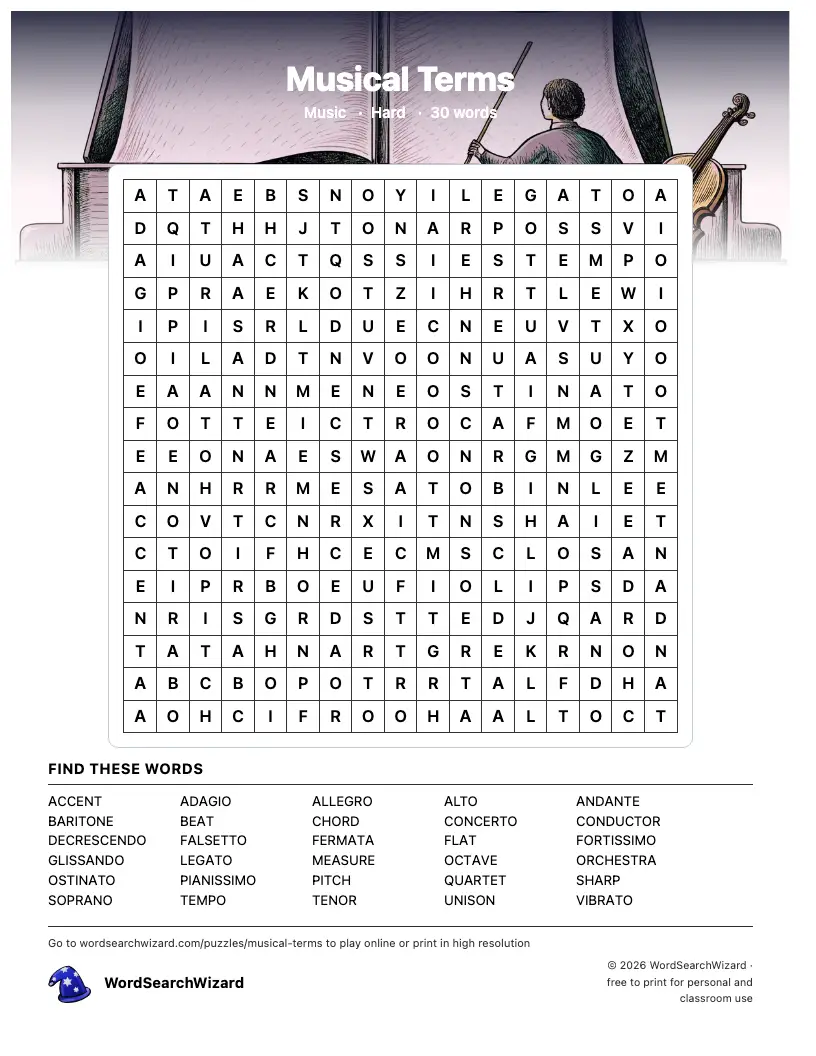
Musical Terms Word Search Answer Key
Checking a finished sheet, or stuck on the last word? The Musical Terms Word Search Answer Key marks all 30 hidden words in the grid and lists the row, column and direction each one starts from. It prints on its own sheet, so you can hand out the puzzle and keep the answers.
Show the completed answer key Hide the answer key
More puzzles to play
-
Katseye
-
BTS
-
K-Pop
-
The Beatles
-
Eminem Songs
-
Famous songs from 2016

-
Guitar Terms
-
Music Genre Word Search
Browse all Music word searches.