Largest Bodies of Water
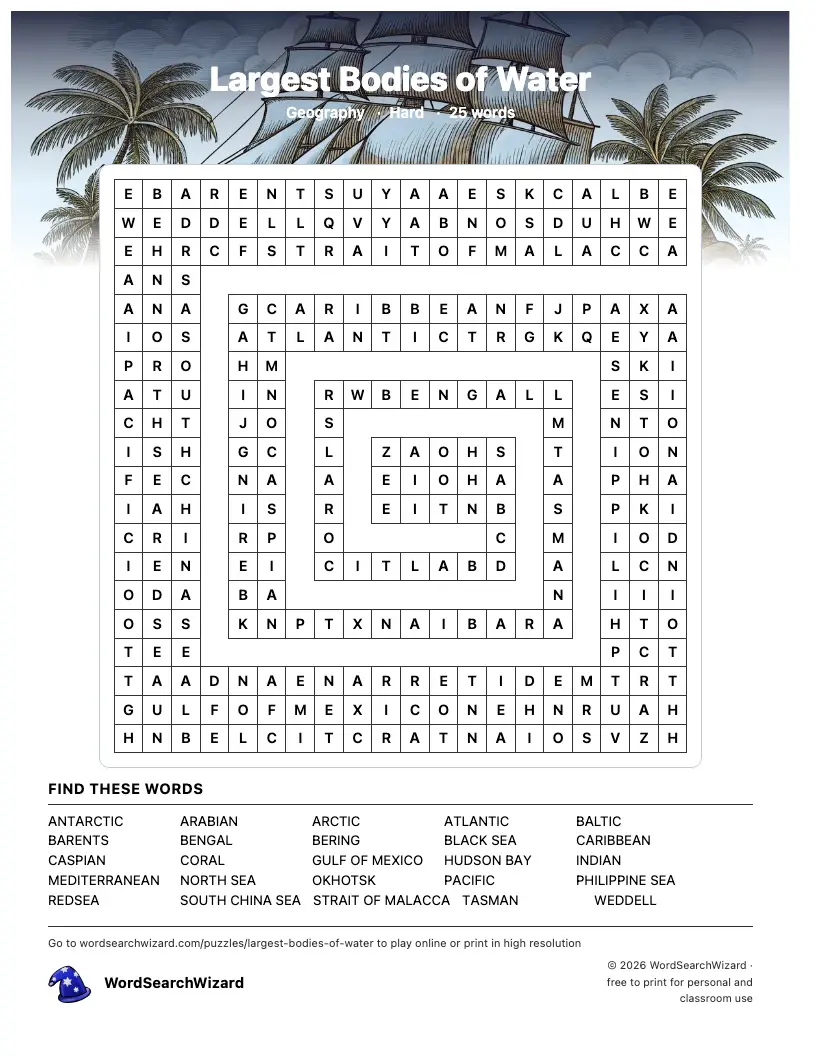
| E | B | A | R | E | N | T | S | U | Y | A | A | E | S | K | C | A | L | B | E |
| W | E | D | D | E | L | L | Q | V | Y | A | B | N | O | S | D | U | H | W | E |
| E | H | R | C | F | S | T | R | A | I | T | O | F | M | A | L | A | C | C | A |
| A | N | S | |||||||||||||||||
| A | N | A | G | C | A | R | I | B | B | E | A | N | F | J | P | A | X | A | |
| I | O | S | A | T | L | A | N | T | I | C | T | R | G | K | Q | E | Y | A | |
| P | R | O | H | M | S | K | I | ||||||||||||
| A | T | U | I | N | R | W | B | E | N | G | A | L | L | E | S | I | |||
| C | H | T | J | O | S | M | N | T | O | ||||||||||
| I | S | H | G | C | L | Z | A | O | H | S | T | I | O | N | |||||
| F | E | C | N | A | A | E | I | O | H | A | A | P | H | A | |||||
| I | A | H | I | S | R | E | I | T | N | B | S | P | K | I | |||||
| C | R | I | R | P | O | C | M | I | O | D | |||||||||
| I | E | N | E | I | C | I | T | L | A | B | D | A | L | C | N | ||||
| O | D | A | B | A | N | I | I | I | |||||||||||
| O | S | S | K | N | P | T | X | N | A | I | B | A | R | A | H | T | O | ||
| T | E | E | P | C | T | ||||||||||||||
| T | A | A | D | N | A | E | N | A | R | R | E | T | I | D | E | M | T | R | T |
| G | U | L | F | O | F | M | E | X | I | C | O | N | E | H | N | R | U | A | H |
| H | N | B | E | L | C | I | T | C | R | A | T | N | A | I | O | S | V | Z | H |
- ANTARCTIC
- ARABIAN
- ARCTIC
- ATLANTIC
- BALTIC
- BARENTS
- BENGAL
- BERING
- BLACK SEA
- CARIBBEAN
- CASPIAN
- CORAL
- GULF OF MEXICO
- HUDSON BAY
- INDIAN
- MEDITERRANEAN
- NORTH SEA
- OKHOTSK
- PACIFIC
- PHILIPPINE SEA
- REDSEA
- SOUTH CHINA SEA
- STRAIT OF MALACCA
- TASMAN
- WEDDELL
Print this puzzle
The Pacific and Atlantic dominate Earth's surface, but smaller seas hold their own. Discover the Mediterranean, Caribbean, and Arctic alongside the world's mightiest water bodies.
Prefer to check your work on screen? Open the answer key page.
A new printable every Monday. We'll email you a hard word search to print every Monday — for a class, an activity table or your own coffee break. Stop any time. Printing for a class? This month’s print pack has a sheet for every week.
Tips for Solving Word Search Puzzles
Words in this puzzle run straight across or straight down, forwards or backwards, and never diagonally. Knowing the rules narrows the search before you start.
How hints work
Press and hold a word in the list beside the puzzle above, or hold Space or Enter on it from the keyboard, and a ring fills while you wait. After five seconds every cell where that word's first letter appears is outlined in the grid. Keep holding another six seconds and the outlines narrow to only the places where its second letter follows on. Let go and the outlines clear. A word found with help keeps its outline, in the grid and in the list, so you can see afterwards which ones needed a hint. Hints are available while the clock is running, not while the puzzle is paused.
Ways to find a stubborn word
- Check the edges for long words. A long word needs a long straight run of cells, and the outer rows and columns are where those runs tend to begin or end. Trace the border first.
- Hunt the rare letter, not the first one. A word that contains a J, Q, X, Z, K, W or V is easier to find by that letter than by its opening one: there are far fewer of them on the grid, and each one you find is a candidate to read outward from in every allowed direction.
- Search the open ground. Once several words are marked, the remaining ones are hiding in the areas nothing crosses yet. Give the untouched patches your attention before re-reading rows you have already combed.
- Look for doubled letters and fixed pairs. LL, OO, EE, TH and QU stand out at a glance. Find the pair, then check whether the rest of the word runs from it.
- Scan one direction at a time. Run your eye along every row looking only for the word's first two letters, then down every column, then along the diagonals if the puzzle allows them. One direction per pass is faster than switching on every cell.
- Read the endings. If words here can run backwards, an ending like ING, TION or ER is as good a handle as the start: spot it, then read back the other way.
- Take the longest words first. They have the fewest possible positions, and marking them carves the grid into smaller regions for everything shorter.
- Pause when you are stuck. Pause stops the clock. A fresh look after a minute away finds what a tired one keeps missing, and Shuffle gives you a new arrangement of the same words if you would rather start over.
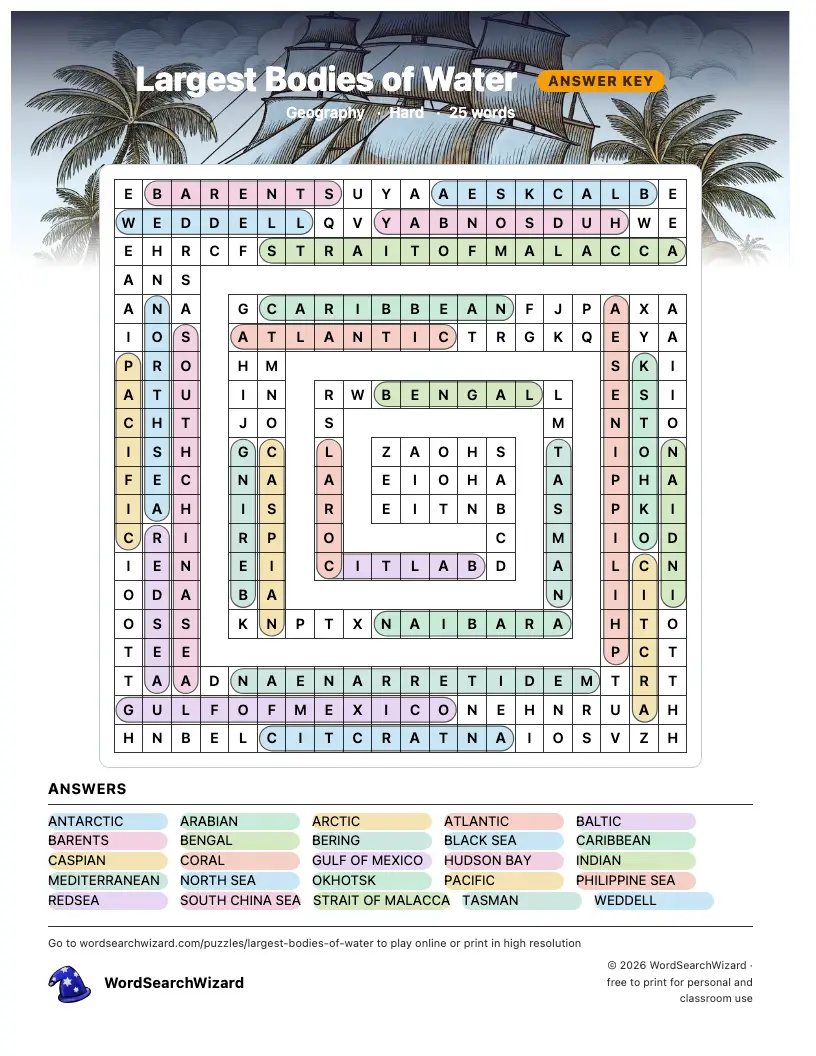
Largest Bodies of Water Word Search Answer Key
Checking a finished sheet, or stuck on the last word? The Largest Bodies of Water Word Search Answer Key marks all 25 hidden words in the grid and lists the row, column and direction each one starts from. It prints on its own sheet, so you can hand out the puzzle and keep the answers.
Show the completed answer key Hide the answer key
More puzzles to play
-
Chesapeake, Virginia
-
Countries in Asia

-
Mountains of the World
-
Bismarck, North Dakota
-
US Virgin Islands
-
Islands of the Atlantic Ocean
-
The State of West Virginia
-
Continents and Oceans
Browse all Geography word searches.