Elephants: Earth's Largest Land-Animals
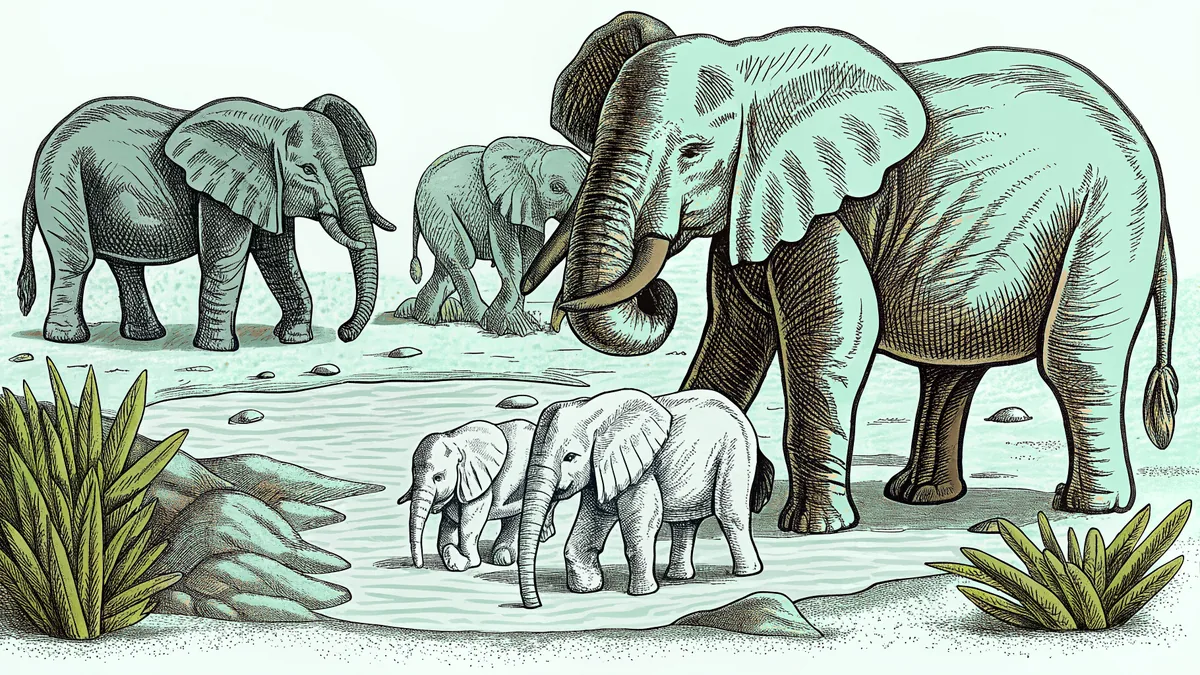
| W | I | O | E | T | A | D | R | O | H | C | K | M | E | P |
| E | O | O | D | N | U | O | S | A | R | F | N | I | A | T |
| B | G | C | H | T | A | B | D | U | M | S | L | K | N | H |
| E | U | N | J | U | N | G | L | E | I | F | S | E | N | A |
| H | H | L | I | N | T | A | R | C | C | U | U | V | I | I |
| A | I | T | L | T | F | R | S | A | T | G | O | I | P | L |
| B | C | T | G | R | E | O | E | K | N | U | R | T | S | A |
| I | S | A | I | N | B | P | E | S | D | H | O | I | E | N |
| T | S | C | L | O | E | L | M | P | E | I | V | N | I | D |
| A | A | T | R | V | E | R | O | U | B | D | I | G | S | S |
| T | R | P | H | P | E | W | T | B | R | A | B | O | M | A |
| A | G | E | H | A | E | S | S | S | E | T | R | C | I | F |
| A | R | A | I | R | M | A | M | M | A | L | E | K | C | A |
| D | N | S | A | V | A | N | N | A | H | J | H | N | O | R |
| T | A | H | H | N | P | A | C | H | Y | D | E | R | M | I |
- AFRICA
- ASIA
- BARK
- BULL
- CALVES
- CHORDATE
- COGNITIVE
- COW
- DESERT
- ELEPHANT
- GRASS
- HABITAT
- HERBIVOROUS
- HERD
- INFRASOUND
- JUNGLE
- MAMMAL
- MUDBATH
- PACHYDERM
- PINNAE
- POWER
- PROBOSCIS
- SAFARI
- SAVANNAH
- SEISMIC
- STRENGTH
- THAILAND
- TRUMPETING
- TRUNK
- TUSK
Get a new puzzle every Monday
One hard word search by email. Free, stop any time.
Print this puzzle
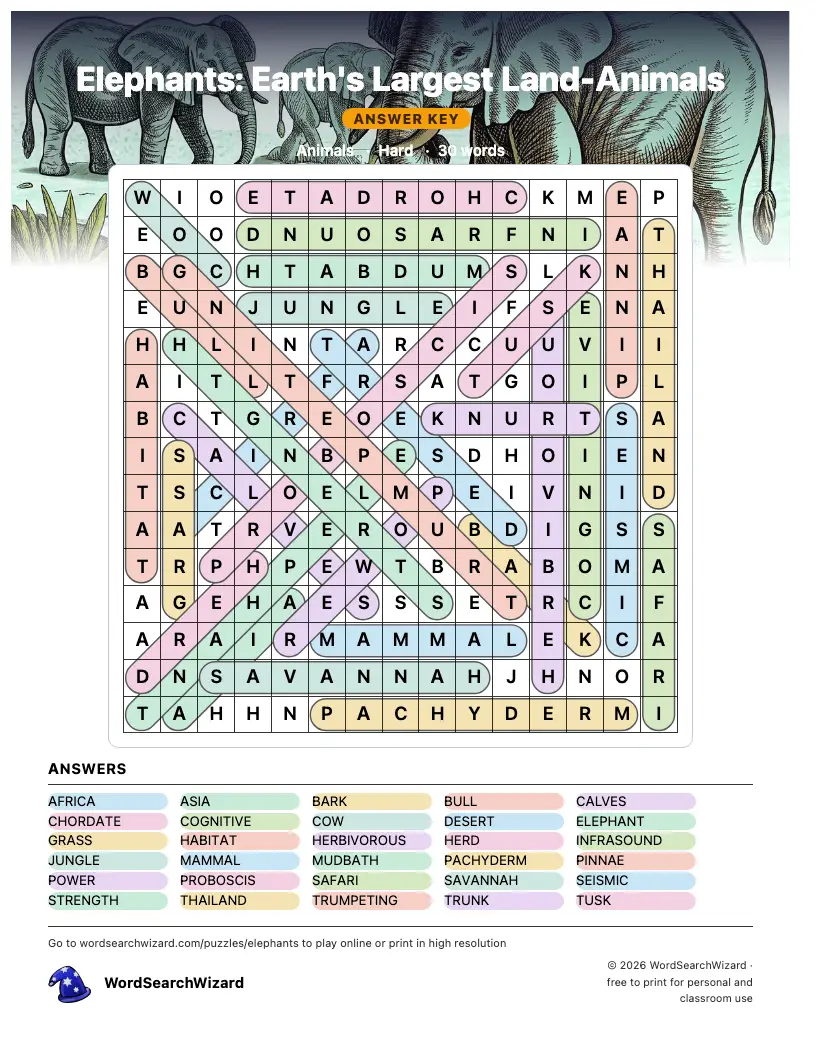
Elephants are the largest land animals alive today. Bulls and cows raise their calves in a herd across Africa and Asia, grazing grass and bark in habitats from jungle to desert. Highly cognitive and herbivorous, they communicate over long distances using infrasound below what a chordate ear can hear.
Prefer to check your work on screen? Open the answer key page.
Printing for a class? This month’s print pack has a sheet for every week.
Tips for Solving Word Search Puzzles
Words in this puzzle run in all eight directions: across, down and diagonally, and some of them read backwards. Knowing the rules narrows the search before you start.
How hints work
Press and hold a word in the list beside the puzzle above, or hold Space or Enter on it from the keyboard, and a ring fills while you wait. After five seconds every cell where that word's first letter appears is outlined in the grid. Keep holding another six seconds and the outlines narrow to only the places where its second letter follows on. Let go and the outlines clear. A word found with help keeps its outline, in the grid and in the list, so you can see afterwards which ones needed a hint. Hints are available while the clock is running, not while the puzzle is paused.
Ways to find a stubborn word
- Check the edges for long words. A long word needs a long straight run of cells, and the outer rows and columns are where those runs tend to begin or end. Trace the border first.
- Hunt the rare letter, not the first one. A word that contains a J, Q, X, Z, K, W or V is easier to find by that letter than by its opening one: there are far fewer of them on the grid, and each one you find is a candidate to read outward from in every allowed direction.
- Search the open ground. Once several words are marked, the remaining ones are hiding in the areas nothing crosses yet. Give the untouched patches your attention before re-reading rows you have already combed.
- Look for doubled letters and fixed pairs. LL, OO, EE, TH and QU stand out at a glance. Find the pair, then check whether the rest of the word runs from it.
- Scan one direction at a time. Run your eye along every row looking only for the word's first two letters, then down every column, then along the diagonals if the puzzle allows them. One direction per pass is faster than switching on every cell.
- Read the endings. If words here can run backwards, an ending like ING, TION or ER is as good a handle as the start: spot it, then read back the other way.
- Take the longest words first. They have the fewest possible positions, and marking them carves the grid into smaller regions for everything shorter.
- Pause when you are stuck. Pause stops the clock. A fresh look after a minute away finds what a tired one keeps missing, and Shuffle gives you a new arrangement of the same words if you would rather start over.
What the words in this puzzle mean
- AFRICA
- Home to two of the three living species, the bush elephant and the smaller forest elephant.
- ASIA
- Home to the third species, smaller-eared and the one most often trained to work with people.
- BARK
- Stripped from trees and eaten for its fibre and minerals, which reshapes whole woodlands.
- BULL
- An adult male, who leaves the herd as a teenager and lives largely alone.
- CALVES
- Newborns weigh about 120 kilograms and can stand within an hour of birth.
- CHORDATE
- The phylum elephants belong to — animals with a nerve cord down the back.
- COGNITIVE
- Describing their mental abilities: elephants use tools, mourn their dead and recognise themselves in mirrors.
- COW
- An adult female. Herds are made of related cows and their young, led by the oldest.
- DESERT
- Namibia and Mali hold desert-adapted elephants that walk enormous distances between water.
- ELEPHANT
- The largest land animal alive, and the only surviving member of the order Proboscidea.
- GRASS
- The bulk of their diet; an adult can eat 150 kilograms of plant matter a day.
- HABITAT
- The savannah, forest and scrub they need — and the thing they are steadily losing.
- HERBIVOROUS
- Plant-eating. Their digestion is inefficient, which is why they must eat almost constantly.
- HERD
- A family group of related females and calves, led by the oldest and most experienced cow.
- INFRASOUND
- Calls below human hearing, which carry for miles and let separated herds stay in contact.
- JUNGLE
- Dense forest where the African forest elephant and many Asian elephants live.
- MAMMAL
- Warm-blooded, milk-feeding; elephants carry a calf for 22 months, the longest of any mammal.
- MUDBATH
- Wallowing coats the skin in mud, which blocks sun and parasites better than bare hide.
- PACHYDERM
- An old grouping for thick-skinned animals; zoologists no longer treat it as a real category.
- PINNAE
- The external ears. Their huge surface loses heat, working as radiators as much as for hearing.
- POWER
- An adult can push over a tree, which is why elephants shape the landscape around them.
- PROBOSCIS
- The scientific name for the trunk, and the root of the order name Proboscidea.
- SAFARI
- The overland journey on which most people see elephants in the wild.
- SAVANNAH
- Open grassland with scattered trees, the classic African elephant country.
- SEISMIC
- Ground vibrations elephants detect through their feet, another channel for distant signals.
- STRENGTH
- A trunk alone holds about 40,000 muscle units and can lift several hundred kilograms.
- THAILAND
- A country where Asian elephants have worked with people for centuries and are a national symbol.
- TRUMPETING
- The loud blast made through the trunk, used in alarm, excitement and threat.
- TRUNK
- A fused nose and upper lip, used to breathe, smell, drink, grip and touch.
- TUSK
- An overgrown incisor tooth. Ivory demand is why tusked elephants have been hunted so heavily.
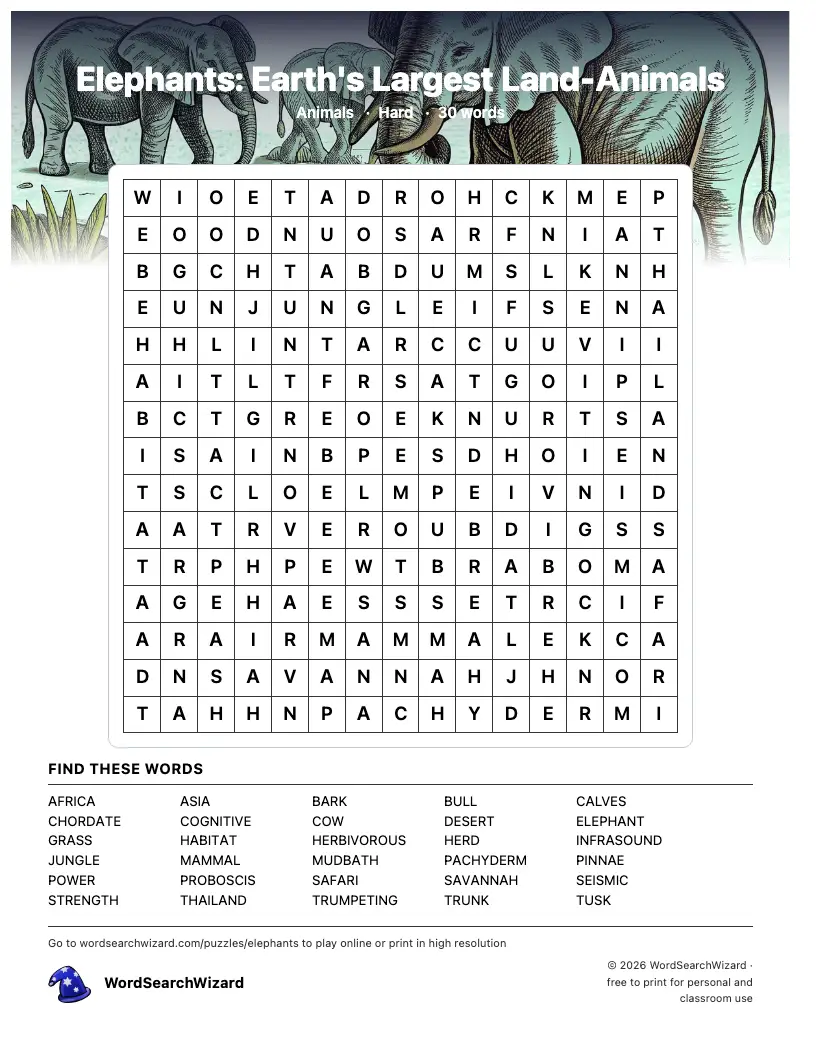
Elephants: Earth's Largest Land-Animals Word Search Answer Key
Checking a finished sheet, or stuck on the last word? The Elephants: Earth's Largest Land-Animals Word Search Answer Key marks all 30 hidden words in the grid and lists the row, column and direction each one starts from. It prints on its own sheet, so you can hand out the puzzle and keep the answers.
Show the completed answer key Hide the answer key
More puzzles to play
-
Amphibians!
-
Dog Breeds
-
Popular Aquarium Fish
-
Animals Found in Africa
-
Jungle Animals
-
Different Species of Bears
-
Snakes
-
Garden Birds
Browse all Animals word searches.